Remember and Reweight: Enhancing Multi-Agent Debate with
Experience Memory and Confidence Estimation



This repository contains the source code of R2-MAD (Remember and Reweight for Multi-Agent Debate), proposed in Remember and Reweight: Enhancing Multi-Agent Debate with Experience Memory and Confidence Estimation (EMNLP 2026 Findings).
Introduction
Multi-agent debate (MAD) improves LLM reasoning by having multiple agents iteratively refine their responses through discussion, but it suffers from shared misconception: when a majority of agents initially converge on a wrong answer, debate amplifies the error instead of correcting it. To mitigate this weakness, we propose R2-MAD, a framework that equips agents with an experience memory accumulated from past debates. A single retrieval in each debate round serves two complementary purposes — Remember: a debate-state-aware policy dynamically calibrates the agent's prior belief by retrieving relevant historical evidence based on the current consensus level; Reweight: those retrieved cases estimate how reliable each peer's current stance has proven historically, weighting its influence on the next round.
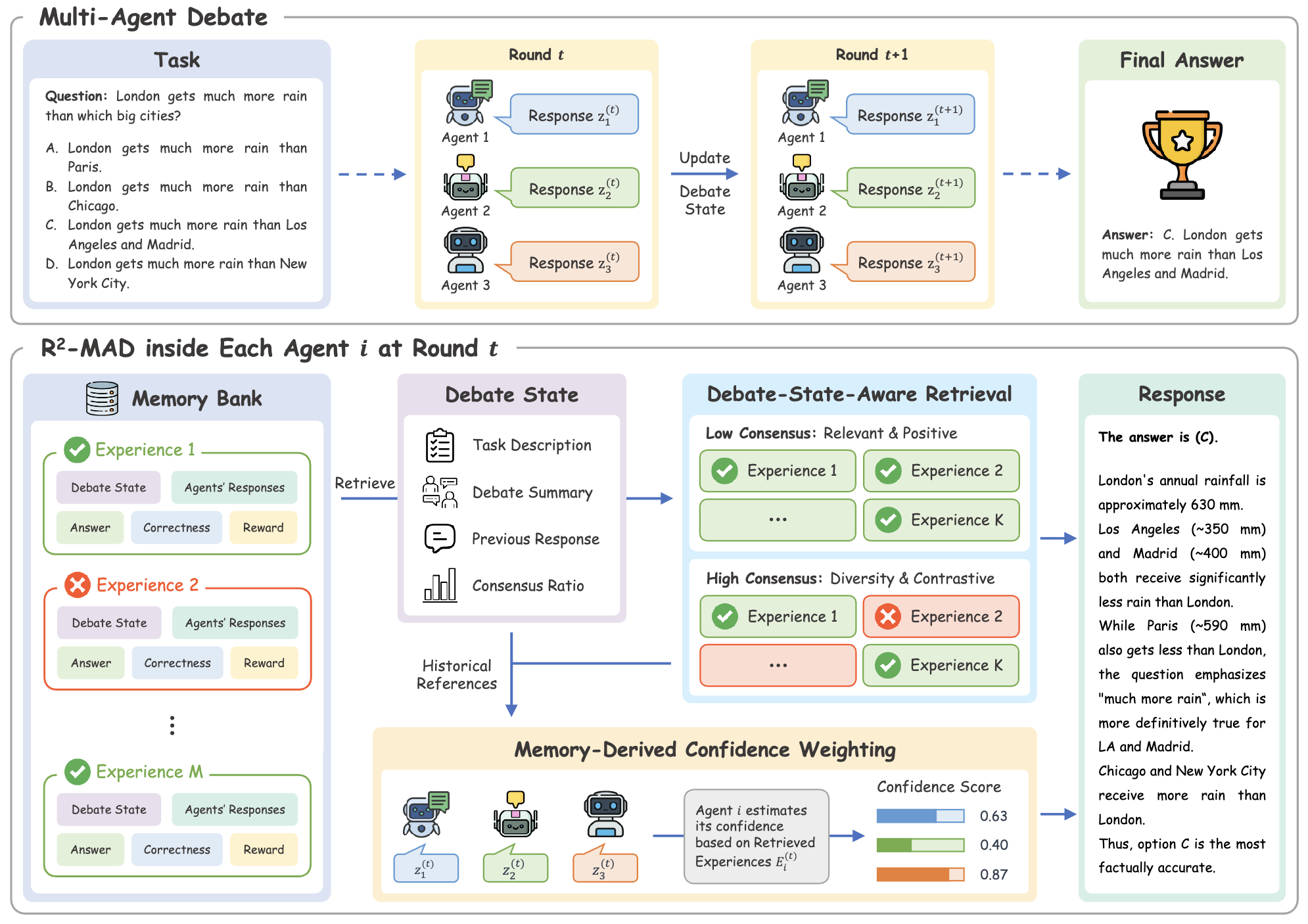
Figure 1. Overview of the R2-MAD framework. At each debate round, agent $i$ retrieves relevant experiences from its memory bank via a debate-state-aware policy, uses them to calibrate its prior concepts and estimate confidence weights for each peer, and then generates an updated response.
Project Structure
R2-MAD/
├── configs.yaml                 # Model registry: local vLLM + remote API models
├── download_datasets.py         # Fetch raw datasets from HuggingFace
├── prepare_data.py              # Build train/test JSONL splits
├── prepare_memory.py            # Build the ChromaDB memory store
├── run_mad.py                   # MAD / R2-MAD entry point
├── run_cot.py                   # CoT / Self-Consistency baselines
├── scripts/                     # Batch scripts sweeping all models x tasks
└── src/
    ├── multi_agent_debate.py    # Debate orchestration
    ├── agent.py                 # Per-debater prompting + memory pipeline
    ├── retrieval_policy.py      # Pluggable retrieval policies
    ├── memory.py                # ChromaDB vector store wrapper
    ├── models.py                # vLLM / OpenRouter backends + embedding model
    ├── checker.py               # Per-task answer parsing and matching
    ├── prompts.py               # Per-task, per-persona system prompts
    ├── paths.py                 # All directory constants (derived from repo root)
    └── utils/                   # Config, data, memory-case, token-usage helpers
Setups
Environment
Inference runs locally on GPUs via vLLM.
conda create -n r2mad python=3.12 -y
conda activate r2mad

pip install vllm==0.8.5          # pulls a matching torch==2.6.0
pip install -r requirements.txt
Download the NLTK corpus used for memory-case text processing:
python -c "import nltk; nltk.download('punkt_tab')"
Models
Register models in configs.yaml. Each entry declares a backend:
qwen3-8b:
  backend: vllm                  # local GPU
  model: "Qwen/Qwen3-8B"
  model_path: null               # optional: on-disk weights; null = download from HF

gpt-4o-mini:
  backend: openrouter            # remote API
  model: "openai/gpt-4o-mini"
--model_name selects the entry, so the same scripts drive either backend with no flag changes.
For the OpenRouter backend, copy the env template and fill in your key:
cp .env.template .env # then set OPENROUTER_API_KEY
Datasets
Download the raw datasets from HuggingFace → data/:
python download_datasets.py --dataset_name math500
python download_datasets.py --dataset_name mmlu_pro
python download_datasets.py --dataset_name truthfulqa
Then build the train/test splits → processed_data/. Note the naming difference: MMLU-Pro is downloaded once but processed twice, one subject per call.
python prepare_data.py --dataset_name math500
python prepare_data.py --dataset_name mmlu_pro_engineering
python prepare_data.py --dataset_name mmlu_pro_economics
python prepare_data.py --dataset_name truthfulqa
Run Experiments
Run all commands from the repository root — src/ is imported as a namespace package.
Building the memory
The memory bank must be built before it can be used at inference.
Step 1 — Collect debate experience → memory_data/
--train runs debates on the training split, forces every query through all rounds, and writes one JSONL record per (query, agent, round).
scripts/run_collect_memory.sh
Step 2 — Build the memory bank → persistent_memory/
Creates a ChromaDB collection named <task>_<model> plus a _doc_embeddings.npz sidecar of pre-computed embeddings (so MMR re-ranking never re-encodes). This drops and recreates the collection on each run.
scripts/run_prepare_memory.sh
Single run
# Full R2-MAD
python run_mad.py --task <task> --model_name <debater_model> \
  --n_retrieval <K> --gpu_id <gpu> --embed_gpu_id <embed_gpu> \
  --if_summarize_state --if_use_memory --memory_model <memory_model> \
  --if_confidence_weight --save_log
Placeholders: <task> is one of the four benchmark names, <debater_model> and <memory_model> are keys in configs.yaml, <K> is the number of final retrieved cases for each debater, and <gpu> / <embed_gpu> are device indices.
Key arguments
| Flag | Description |
|---|---|
--task |
MATH500, MMLUPro_Engineering, MMLUPro_Economics, TruthfulQA |
--model_name |
Debater model; must match a configs.yaml entry |
--memory_model |
Model whose memory collection to retrieve from; falls back to --model_name |
--n_agents |
Number of debaters (max 6 — one persona each, see prompts.py) |
--max_round |
Maximum debate rounds |
--consensus_threshold |
Fraction of agents that must agree to stop early |
--if_use_memory |
Enable experience-memory retrieval |
--if_confidence_weight |
Enable memory-based confidence weighting |
--if_summarize_state |
Summarize debate state |
--n_retrieval |
Cases injected into the prompt |
--retrieval_policy |
Retrieval policies supported in src/retrieval_policy.py, default: debate_state_aware |
--gpu_id / --embed_gpu_id |
GPU for the LLM / for the embedding model; the latter shares the former unless set |
--exp_name |
Output filename prefix used to label variants |
--limit |
Cap the number of questions (quick tests) |
--save_log |
Write results to logs/ |
Note: the debater model at inference and the model used to build memory are decoupled. All our experiments retrieve from a memory built by one fixed model, so that variation in memory quality across different builder models does not confound the comparison between debaters.
Batch runs for main results and baselines
We also provide scripts that can sweep all models × all tasks:
scripts/batch_run_r2mad.sh      # R2-MAD
scripts/batch_run_cot.sh        # CoT baseline
scripts/batch_run_sc.sh         # Self-consistency (9 paths)
scripts/batch_run_mad.sh        # Vanilla MAD
Citation
If you find this work useful, please cite:
@article{jin2026remember,
  title={Remember and Reweight: Enhancing Multi-Agent Debate with Experience Memory and Confidence Estimation},
  author={Jin, Xuanfa and Ma, Zhijian and Zeng, Yongcheng and Cui, Xinyu and Zhang, Haifeng and Wang, Jun},
  journal={arXiv preprint arXiv:2609.03619},
  year={2026},
  url={https://arxiv.org/abs/2609.03619}
}
License
Released under the MIT License.